The Challenge: Physical Components as Drama
How do you design a tabletop experience that feels as tense and cinematic as a Western standoff, while staying intuitive enough for casual players? I set myself a specific challenge: translate the psychological drama of "bullet-time" decision-making into physical components that anyone could pick up and play.
The tension in a standoff comes from hidden intent and simultaneous action—you can't react to your opponent, only anticipate them. But tabletop games often struggle with pacing: too much setup kills tension, while too little structure makes outcomes feel arbitrary. I wanted to explore how physical game pieces could embody narrative stakes without requiring complex rules or fiddly components.
The solution came through designing around the reveal. I built a simultaneous-choice system where players commit to moves in secret, then unveil them at the same moment—mirroring the core drama of a duel where hesitation means death.
The dual-spinner system became the mechanical heart: players secretly position Aim and Stance spinners built directly into their character cards, creating rock-paper-scissors-style interaction where success depends on reading your opponent. After revealing spinners, players race to slam down a Technique card—the faster player acts first, adding physical urgency to strategic choice.
Through rapid prototyping and small-group playtests, I refined every tactile detail: the satisfying click of spinners, the weight of cards, the visual clarity of iconography. The result demonstrates how simple physical interactions can create complex psychological tension—a principle that translates directly to digital UX design.
The Spinner Mechanic
The dual-spinner system eliminates luck-based outcomes in favor of psychological gameplay. Players secretly position their Aim (where you're shooting) and Stance (how you're positioned), then reveal simultaneously. Success hinges on anticipating your opponent's choice rather than hoping for good dice rolls.
Why spinners over dice? Dice introduce randomness where I wanted intention. By letting players set exact values, every outcome becomes a result of strategic commitment rather than chance. The spinner mechanism also ties directly into character Profile Cards, presenting stats and abilities in close proximity to the interaction point—reducing cognitive load during fast-paced play.
The physical act of spinning, setting, and revealing became ritualistic. Players naturally lean in, pause before the reveal, and react viscerally when gambits pay off or bluffs are called. This theatrical quality emerged from the mechanic itself, not from added complexity.
Core Systems
Game Flow: Each duel begins with character selection and an ice-breaker question ("Who last committed a crime?") that sets the outlaw tone while determining turn order. Players then enter a fast-paced loop:
Set spinners secretly → both players position Aim/Stance
Slam Profile cards → reveal spinner positions simultaneously
Speed-draw Technique cards → race to play from hand (faster player acts first)
Resolve → calculate damage and effects
Alternating draw → rebuild hands between rounds
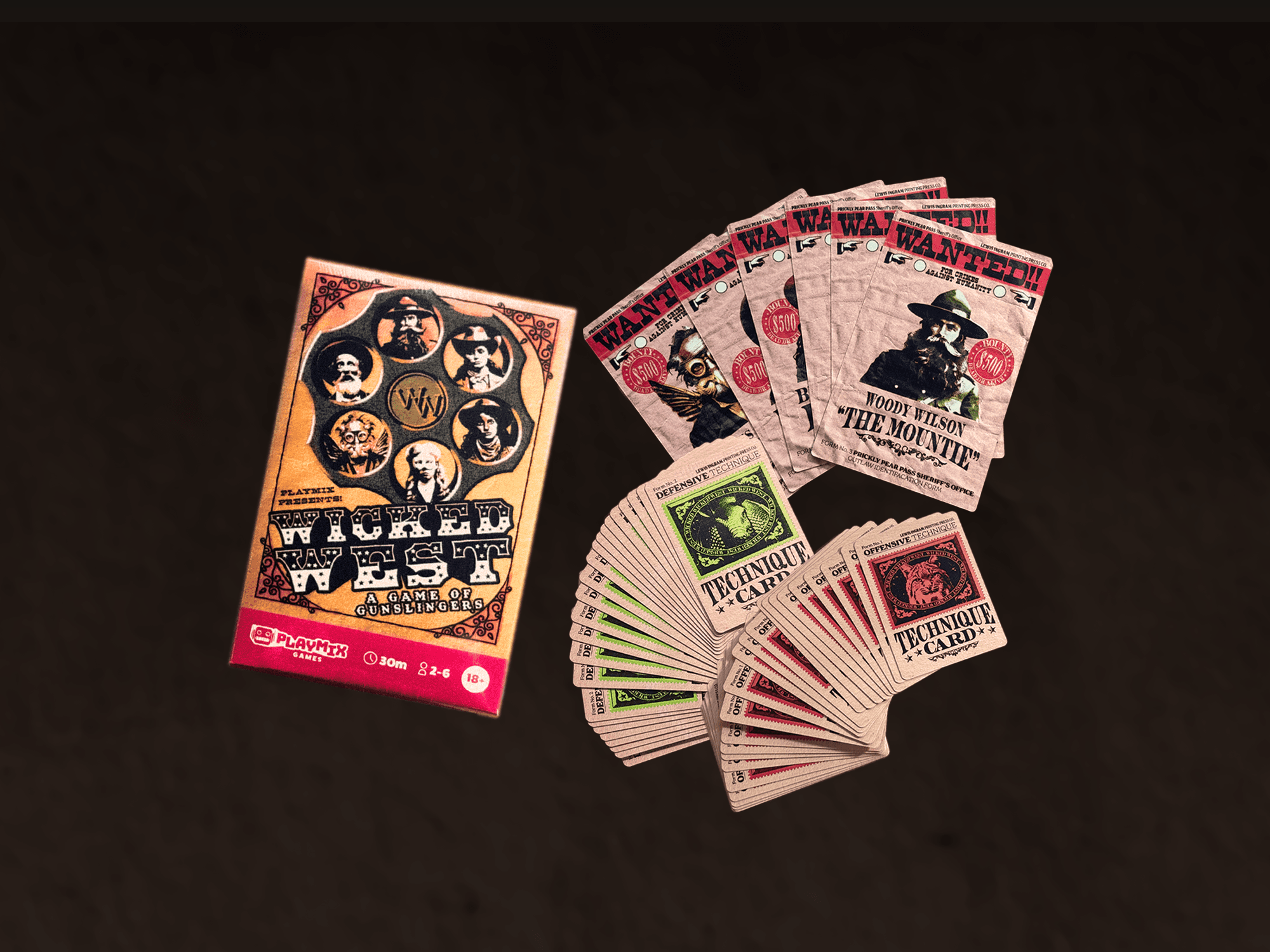
The Two-Card System: Profile Cards (persistent) represent your character—integrated spinners, health tracker, unique abilities, and Last Dance moves that trigger at 1 HP.
Technique Cards (drawn/discarded) represent tactical decisions—48 cards including attacks, defenses, trick shots, and bluffs. The speed-draw mechanic forces split-second choices: you must read revealed spinners, scan your hand, and commit before your opponent does.
This separation of identity (Profile) and action (Technique) creates strategic depth without rules complexity. Your character defines your baseline approach, but moment-to-moment Technique choices create variation and unpredictability.
Visual Design & Accessibility

Because gameplay relies on split-second reads during the speed-draw phase, visual clarity became critical. I designed every element to communicate instantly:
Information Hierarchy:
Bold iconography readable at a glance
Color-coded damage values (red/yellow/white)
Minimal effect text (1-2 sentences maximum)
Card border types indicate function (attack/defense/trick)
Accessibility Considerations: Critical information is never communicated through color alone—shapes, patterns, and icons provide redundant visual cues for colorblind players. The Profile Card layout follows consistent hierarchy: character identity at top, spinner interface center, ability text bottom.
The aesthetic evokes dusty Western wanted posters through hand-drawn illustration and high-contrast design, ensuring thematic cohesion while maintaining functional legibility.
Player Feedback & Iteration
Playtesting revealed that physicality matters deeply in interaction design. The act of spinning, hiding, and revealing isn't just mechanical—it's theatrical. Players naturally embodied their choices through gesture, creating emotional investment that pure strategy games often lack. The spinner's click, the card's weight, the slam of the reveal—these tactile elements weren't cosmetic flourishes. They created ritual and meaning.
Key insights from testing:
Speed creates authentic tension: The race to play Technique cards transformed careful strategy into instinctive decision-making, mirroring the panic of real duels
Constraints drove elegant solutions: Limiting components to spinners + cards forced simpler, more focused mechanics than complex systems might have allowed
Accessibility through clarity: Color-coded damage values and bold iconography let players make split-second decisions without rules lookup
Comeback mechanics matter: Last Dance abilities kept losing players engaged and dangerous, preventing early-game snowballing
Through iterative refinement, I learned core tabletop design principles—balance, pacing, risk/reward structures—that translated directly from digital UX thinking. Information hierarchy, immediate feedback, and reduced cognitive load work just as well in cardboard as on screens.
Final Reflection
Wicked West was a design challenge I set for myself: could I capture cinematic tension through simple physical mechanics? The answer reinforced my belief that strong UX transcends screens. By shaping how players anticipate, commit, and react, even cardboard and brass can deliver emotionally complex experiences.
As my first tabletop design, the project taught me fundamentals about what makes games compelling—maintaining tension across rounds, creating meaningful comeback opportunities, and designing systems where player skill expression feels rewarding. These principles inform every interaction I design, whether digital or physical.
Given more development time, I'd expand the character roster to create distinct playstyles, introduce a campaign mode for persistent progression, and conduct wider playtesting across different player skill levels and accessibility needs. But the core insight remains: the best interactions feel effortless because the hard design work happened before the player ever touched the component.